A tool falls from scaffolding and lands just a few centimetres from a worker. A forklift brushes against a pallet without knocking it over. No one is hurt, so in many companies nothing happens: everyone breathes a sigh of relief and carries on. Yet what has just happened is valuable information, provided free of charge, about the point at which your safety system is close to failing. This is called a near miss, and learning to record and analyze it is one of the most practical ways to prevent a real accident. Let us look at what a near miss is, why almost no one reports it, and how to build a system that works.
What is a near miss (and how it differs from an incident and an occupational injury)
A near miss is an event that could have caused harm to people or property but did not, due to chance circumstances or the timely intervention of a safeguard. It differs from an occupational injury, which causes harm to a person, and from an incident, which can result in property damage or disruption even without injuries. Before all of these comes the hazard: an inherent property, such as an exposed wire. A near miss is the point at which someone interacts with that hazard and escapes harm by a narrow margin.
This distinction is not merely academic: the difference between a near miss and an actual injury often lies not in the organization, but in luck. And luck is not a safety measure.

Why near misses go unreported
Most near misses never reach the people who should analyze them. The reasons are almost always the same, and they are cultural before they are technical. People fear disciplinary consequences or looking bad in front of colleagues. There is the understandable belief that “nothing happened anyway.” Long, complicated forms discourage everyone. And there is the silent killer of every system: the absence of feedback. When people who report an event never see any result, they stop reporting.
Overcoming these barriers means working on the safety culture, not only on procedures. The guiding principle is a no-blame system: reporting is meant to identify which safeguards failed, not to find someone to blame. Training helps spread this common language: our worker safety training course also develops risk awareness and emphasizes the value of reporting.
The Heinrich and Bird pyramids: useful, but to be handled with care
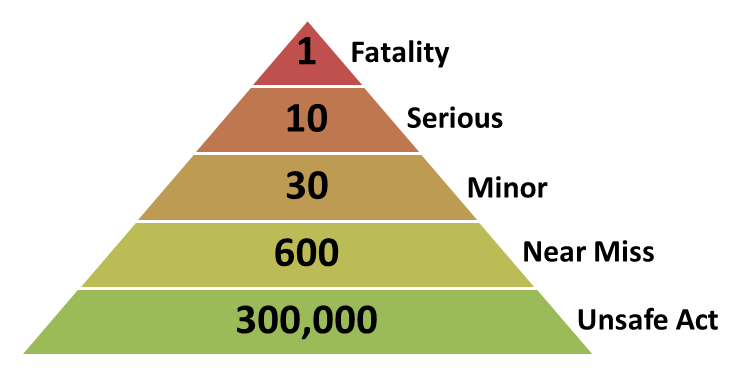
When near misses are discussed, the Heinrich pyramid inevitably comes up. Developed in 1931, it links every serious injury with increasing numbers of minor injuries and near misses (the well-known 1-29-300 ratio); in the 1960s, Bird proposed an updated version of the model (1-10-30-600). The basic idea is intuitive: serious events are the tip of an iceberg made up of weaker warning signals.
The message remains valid, but the figures are far less reliable. Those ratios came from specific, outdated datasets, and more recent literature has challenged them: they are not a scientific law, and not every near miss has the same potential severity. The principle therefore remains useful—weak signals matter—but not the exact proportion.
From reporting to action: record, analyze, correct
Recording without analyzing creates an archive, not a prevention system. A near miss becomes useful only when it leads to analysis, decisions, feedback, and verification. The essential process is simple: a quick report (which may also be anonymous, using a short form or QR code), an assessment of the potential severity, a cause analysis, and a corrective action communicated to the person who made the report.
The core of the process is cause analysis. Root cause analysis shifts attention from the symptom to the underlying conditions instead of stopping at “human error.” The 5 Whys method is the starting point for simple events. For more complex cases, it can be supported by an Ishikawa diagram or a cause tree. One detail surprises many employers: if reports increase, it is usually a good sign, because it means people trust the system.
Near misses, the DVR, and the law
From a legal standpoint, it is important to be clear without inventing obligations. Italian Legislative Decree 81/08 does not require a standalone “near-miss register,” but it does require employers to assess all risks, update the Risk Assessment Document (DVR) and continuously improve safety standards (Articles 17, 28, and 30). From this perspective, near misses can feed into risk assessment and demonstrate the effectiveness of the organizational model. This is where our DVR preparation service comes in: an up-to-date document also takes account of what near misses reveal.
Please note a recent development: according to industry sources, Article 15 of Decree-Law 159/2025, converted into Law 198/2025, may have introduced an obligation for companies with more than 15 employees to record, analyze, and report near misses. If confirmed, this would turn near-miss management from good practice into a formal compliance requirement—another reason to prepare now.
Turning near misses into practical prevention
Recording and analyzing near misses is not extra bureaucracy: it is the most cost-effective way to correct problems before they become real injuries. It requires a clear method, a no-blame culture, and the willingness to follow up on every report. This is work we manage every day, supporting companies with real consultants and training valid throughout Italy. If you manage prevention directly, our employer RSPP course gives you the tools to set everything up correctly. Let us talk: your company’s safety can start here.
Frequently asked questions from clients
Here are the questions our clients ask us most often.
- Is recording near misses mandatory? Italian Legislative Decree 81/08 does not require a specific near-miss register, but it does require employers to assess all risks and continuously improve safety. Collecting near-miss reports is therefore a strongly recommended good practice. However, pay attention to the most recent regulatory developments, which, according to industry sources, may introduce obligations for companies above a certain size threshold. These developments should be verified before being treated as established requirements.
- What does a “no-blame” system mean? It means reporting is used to identify which safeguards failed, not to punish the person who reports the event. It does not mean that responsibility disappears: it distinguishes a good-faith error from an organizational deficiency and from a deliberate violation. This is the prerequisite for people to speak up; without confidence that they will not be punished, near misses remain invisible.
- Does an increase in reports mean safety is getting worse? Usually not—quite the opposite. In the early stages, an increase in reports shows that workers trust the system and are observing risks more carefully. The number alone says little: what matters is the quality of the data, how quickly reports are handled, and whether actions are completed. A company with zero reports is not necessarily safer; often, it is simply a company where no one reports.