
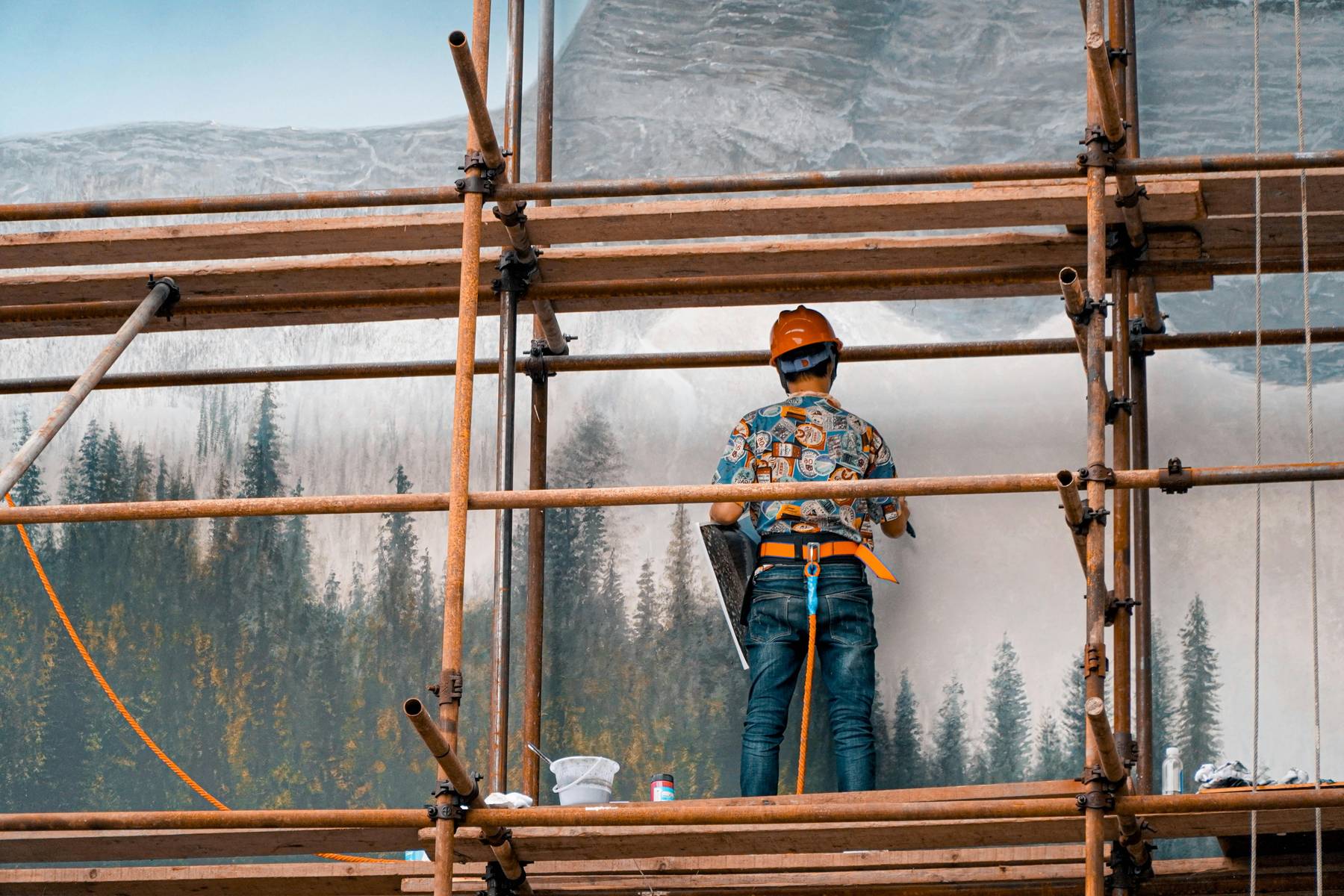
A fall from a height of just two metres can change a person’s life forever. Falls from a height remain the leading cause of serious and fatal accidents in the workplace in Italy, yet many accidents could be prevented with the right procedures and proper training. This article explains what is meant by working at height, what safety measures the legislation requires, what risks specific activities such as rope access or scaffolding work entail, and, above all, what compulsory training is required to work in compliance with Legislative Decree 81/08.
When working at height, knowing exactly what to do is no minor detail: it is the difference between returning home safely and not returning at all!
What is meant by work at height under Legislative Decree 81/08
Work at height is defined, according to Article 107 of Legislative Decree 81/08, as any work activity that exposes the worker to the risk of falling from a height of more than two metres above a stable surface. The definition is precise and leaves no room for interpretation: a height of just 2 metres above the ground is sufficient to trigger all the obligations set out in the Consolidated Law on Safety.
This definition covers a wide range of activities: from maintaining electrical installations on scaffolding to erecting structures on building sites, from cleaning windows at height to pruning trees. The point is not the type of work, but the height at which it is carried out. For this reason, the employer is required to assess the risk of falling in the Risk Assessment Document (RAD), identifying the technical and organisational measures necessary to protect those working in these conditions.
Safety procedures for working at height
The regulations establish a clear principle: first and foremost, the risk of falling must be eliminated. Where this is not possible, it must be minimised through collective measures such as guardrails, safety nets and scaffolding. Only as a last resort, if none of these solutions is technically feasible, should personal fall protection equipment be used: harnesses, lanyards, restraint systems and lifelines.
Operational procedures involve several key steps. The employer must draw up an operational plan describing the work stages, specific risks and the measures adopted. Before any work begins, the suitability of the equipment, the condition of the protective devices and the correct installation of the anchor points must be checked.
Every worker must be familiar with the emergency procedure in the event of a fall (the so-called rescue plan) because a worker suspended in a harness after a fall has only a few minutes before prolonged suspension itself becomes a hazard. Safety in work at height is not just about equipment: it is about organisation, supervision and the competence of those carrying out the work. And this is where training comes into play.
Work on ropes, scaffolding and ladders: specific risks and protective measures
Not all work at height presents the same level of risk. Rope access work, for example, is among the most complex and heavily regulated activities: the worker operates whilst suspended, supported solely by a system of ropes, and must master positioning, progression and self-rescue techniques. For this reason, the 2012 State-Regions Agreement provides for a specific, dedicated training programme, with compulsory practical exercises.
Work on scaffolding, on the other hand, requires skills relating to the erection, modification and dismantling of structures, with specific training as required by Article 136 of Legislative Decree 81/08. Errors during the erection phase (loose joints, missing planks, inadequate anchoring) are among the most common causes of serious accidents.

Care must also be taken when using ladders at height: a portable ladder that does not meet regulatory requirements or is used on unstable surfaces can turn from a work tool into a risk factor. Ladders must comply with standard EN 131, and their use must always be subject to the risk assessment set out in the Risk Assessment Document.
Mandatory training for working at height
Training for working at height is not optional: it is a legal requirement under Legislative Decree 81/08 and the State-Regions Agreements. Every worker exposed to the risk of falling from a height must receive appropriate theoretical and practical training before accessing work areas.
But training is not just for those who physically work at height. The entire company safety chain must be prepared: the employer, the supervisor overseeing the activities, the Workers’ Safety Representative (WSR) who checks compliance with procedures, and of course every worker involved. Specific training courses are available for each of these roles, with different content, durations and refresher requirements.
The risk associated with working at height falls within the broader classification of workplace risk (low, medium or high), which determines the type of mandatory training required. Companies operating in sectors such as construction, plant engineering or industrial maintenance almost always fall into the medium or high-risk categories, with more extensive training requirements.
Which courses are required and how should you choose them?
Navigating the range of courses for working at height and safety training may seem complicated, but the structure is simpler than you might think. Here are the key categories and the corresponding training programmes.
- General safety training is the starting point for all workers, regardless of the sector. This is supplemented by specific training, which varies according to the risk level of the activity: 8 hours for low risk, 12 for medium risk, 16 for high risk. Those working at height almost always fall into the latter two categories.
- The safety officer (the person responsible for ensuring safety procedures are followed on site) must complete a dedicated 8-hour course, with refresher training every two years. This is a crucial role in work at height, as it is the supervisor who checks that equipment is used correctly and that procedures are followed.
- The Health and Safety Representative (RLS) is entitled to at least 32 hours of training, with annual refresher courses, in order to carry out their representative and supervisory role effectively.
All these training courses are available on our website via e-learning or distance learning, with certificates that are compliant and valid throughout the country. We recommend choosing an accredited provider that does not merely deliver the course, but also guides the company in selecting the right programme based on its specific operational context.
Working safely at height: preparation is key
Working at height leaves no room for improvisation: every step plays a crucial role in preventing accidents. The regulations are clear, responsibilities are defined, and the tools to ensure compliance are available.
Sicurezza Online supports companies on this journey with dedicated consultancy, compliant documentation and specific training courses. One of our technicians is on hand to help you identify exactly what your business needs: contact us to find out about all the courses available.
Frequently Asked Questions
Here are the most common questions we receive from our customers.
- At what height is work considered to be at height? According to Article 107 of Legislative Decree 81/08, work is considered to be at height when it is carried out at a height of more than 2 metres above a stable surface. This threshold applies to all types of work and work environments, regardless of the sector. Once the 2-metre threshold is exceeded, all obligations relating to risk assessment, protective measures and training for the workers involved come into effect.
- Is training for work at height compulsory for all workers? Yes, every worker exposed to the risk of falling from a height must receive specific training before working at height. This requirement is set out in Legislative Decree 81/08 and covers both general safety training and specific training related to the risks of the job.
- How often must safety training for those working at height be updated? Specific training for workers must be updated every 5 years, with a minimum of 6 hours. For the person in charge, the update is biennial, whilst for the Health and Safety Representative (RSL) it is annual. For rope access work, the specific course must be updated every 5 years.
- What fall arrest equipment is required for work at height? Personal protective equipment against falls from a height includes full-body harnesses, lanyards with energy absorbers, connectors and retractable devices. The choice depends on the type of activity, the height and the configuration of the work area. The employer is required to provide compliant, tested equipment suitable for the specific risk, and to train workers in its correct use.
- Can courses for working at height be taken online? The theoretical part of general and specific safety training can be delivered via e-learning or synchronous distance learning, with certificates valid nationwide. For rope access work and activities requiring practical training with Category 3 PPE, however, an in-person practical component is required. A consultant can help you understand which method is suitable for your situation.