
There are risks that cannot be seen or touched, and for this reason they are ignored until the damage is already done. Noise risk and vibration risk fall into this category: they act slowly, day after day, on those who work on construction sites, in workshops, in agriculture or in warehouses. Hearing loss, carpal tunnel syndrome, vascular disorders, chronic back pain. These are recognised occupational diseases, yet too many companies discover they are not compliant only after an inspection or, worse, after a worker has already been harmed.
In this guide we look at what the regulations require, how the assessment works and what is concretely needed to comply.
Exposure to noise and vibrations: what are the risks of ignoring them?
Noise exposure in workplaces is one of the most widespread causes of occupational disease in Italy. When a worker is exposed to high sound levels for prolonged periods, the auditory system undergoes progressive and irreversible deterioration. Noise-induced hearing loss is permanent: there is no going back.
Mechanical vibrations act through the same silent mechanism, but affect different areas of the body. Those who use pneumatic hammers, grinders, chainsaws or brushcutters are exposed to vibrations transmitted to the hand-arm system, with risk of Raynaud's syndrome, neuropathies and joint damage. Those who drive heavy vehicles, forklifts or earth-moving machinery are subject to whole-body vibrations, with effects on the spine and musculoskeletal system.
The common thread is the cumulative nature of these risks: they do not cause an acute event, but accumulate shift after shift, making it difficult to perceive the danger until it is too late.
Noise and vibration risk under Legislative Decree 81/08: obligations for the employer
The Consolidated Act on workplace safety (Legislative Decree 81/08) dedicates two specific chapters to these physical agents: Chapter II for noise and Chapter III for mechanical vibrations. The responsibility for assessment falls entirely on the employer, who must identify, measure and manage the exposure of each worker.
For noise, the regulation sets three thresholds based on the daily exposure level (LEX,8h): lower action value at 80 dB(A), upper at 85 dB(A), limit at 87 dB(A). When noise exceeds 80 dB, progressive obligations apply: information, provision of hearing PPE, health surveillance, containment measures.
For vibrations, the values are differentiated between the hand-arm system (action: 2.5 m/s², limit: 5 m/s²) and whole body (action: 0.5 m/s², limit: 1 m/s²). When action thresholds are exceeded, the employer must adopt technical and organisational measures to reduce exposure.
Penalties for failure to carry out an assessment are significant and can lead to arrest. But there is a more important consideration: a worker who develops a disease due to unassessed exposure is a human, economic and legal harm that no fine can compensate.
Noise risk assessment: how it works and when is it mandatory?
levels. It does not only concern construction sites and workshops: commercial activities, restaurants with noisy kitchens or warehouses with forklifts may also fall within the obligation.
The process involves analysing the sources of noise in the workplace, exposure times and job tasks. In many cases it is possible to carry out an initial assessment without instrumental measurements, based on literature data, machinery data sheets and accredited databases. If the initial analysis reveals exposures close to or above the value between 80 and 85 dB, specific phonometric measurements become necessary.
The results are included in the DVR (Risk Assessment Document), which must report exposure levels per job role, preventive measures adopted and an improvement programme. The assessment must be updated every four years, or sooner if significant changes occur in the production process, machinery or work organisation.
A well-structured example of a noise risk assessment is never a generic document: it must reflect the specific reality of the company, the equipment used and the actual operating conditions.
Vibration risk assessment: hand-arm and whole body
Vibration risk assessment follows a similar logic to the noise assessment, but with an additional complexity: vibrations are divided into two distinct categories, each with different thresholds, measuring instruments and consequences.
- Hand-arm vibrations affect those who use portable tools such as drills, angle grinders, chainsaws or professional lawnmowers. To calculate daily exposure, the employer can use the vibration database published by INAIL and the former ISPESL (available on the Physical Agents Portal), which collects acceleration values for hundreds of pieces of equipment.
- Whole-body vibrations affect those who drive self-propelled vehicles or operate on vibrating platforms. In the construction, agricultural and logistics sectors this is a very frequent and often neglected exposure, with effects on the spine and musculoskeletal system.
For vibrations too, the collected data must be entered in the DVR with the indication of exposure limits for each job role. Mechanical vibrations are not an optional risk: the assessment is always required when the activity involves equipment or vehicles that generate them.

How to comply: DVR, PPE and mandatory training
Properly addressing noise and vibration risk requires three coordinated actions: documentation, protection and training.
The first step is to have an up-to-date and compliant DVR that includes the specific assessment for noise and vibrations. Not a pre-filled document, but an assessment drawn up by qualified technicians based on the company's actual data: equipment in use, exposure times, job roles, workplace layout.
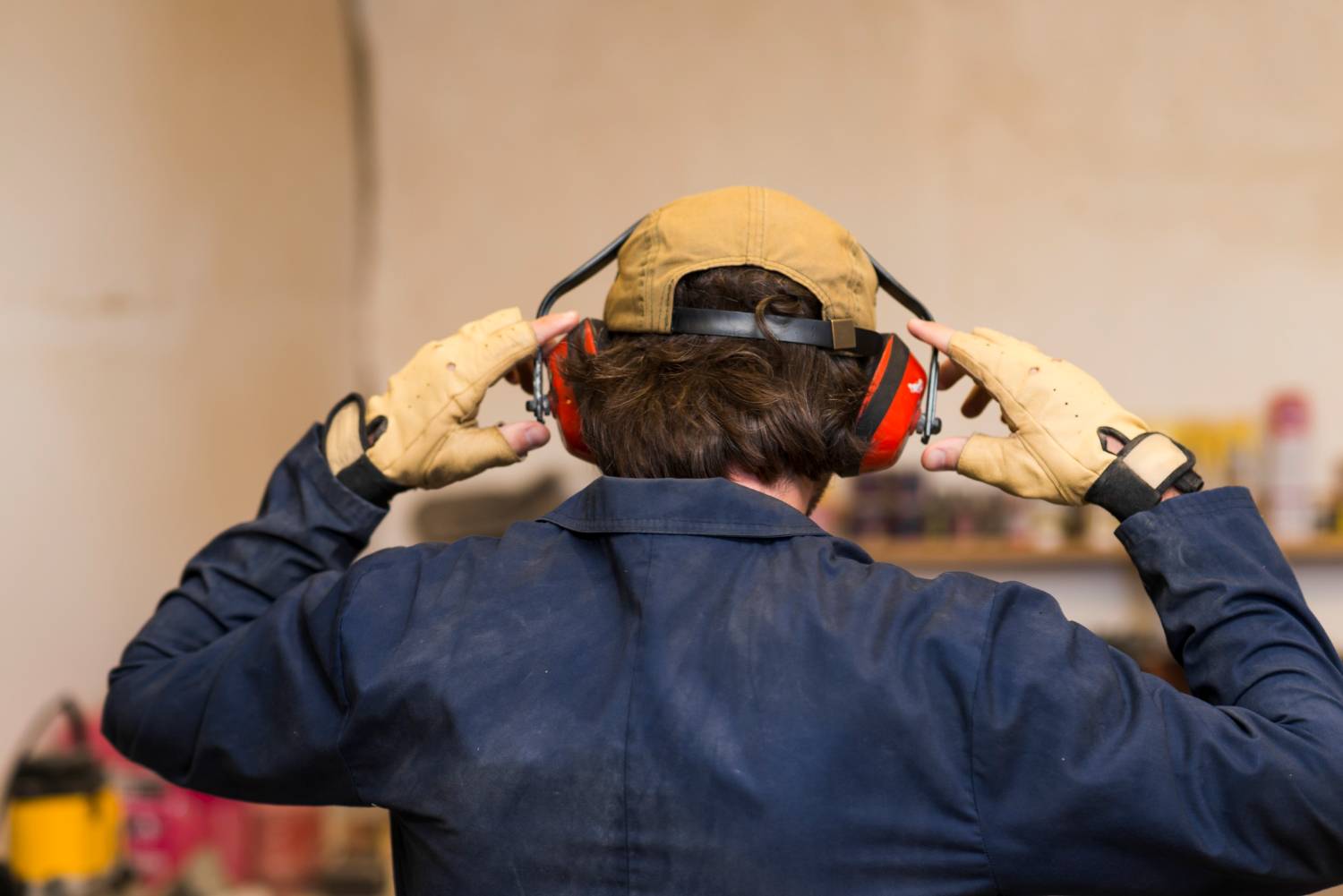
The second concerns PPE: hearing protectors (earmuffs, earplugs) for noise, anti-vibration gloves and cushioned seats for vibrations. The choice of devices must be made based on the exposure levels documented in the assessment, not in a generic way.
The third is mandatory training. Workers exposed to noise and vibrations often fall into high-risk job categories, for which Legislative Decree 81/08 requires specific training courses with periodic updates. Without adequate training, even the best DVR remains incomplete.
We at Sicurezza Online handle all three of these aspects: our technicians draw up the noise and vibration risk assessment tailored to your company, help you identify the right PPE and offer e-learning training courses for high-risk workers. Everything online, at competitive prices, with telephone assistance from dedicated consultants who support you every step of the way.
If you need to bring your business into compliance with the noise and vibration risk assessment, DVR or mandatory training, our consultants are available to assist you at every stage: contact us!
Frequently asked questions from our customers
Here are the most common questions we receive from our customers.
- How often must the noise risk assessment be updated? The assessment must be updated every four years, as required by Legislative Decree 81/08. It must also be reviewed before the deadline if there are changes to equipment, processes, exposure levels or work organisation. The introduction of new machinery or modification of the production layout are also valid reasons for an early update. Our technicians can verify whether your assessment is still valid.
- Is it possible to carry out the vibration risk assessment without instrumental measurements? Yes, in many cases it is possible to use data from the INAIL vibration database (formerly ISPESL), which reports acceleration values for hundreds of work tools. This approach is accepted by the regulations and allows a compliant assessment to be produced without on-site measurements, with significant savings in time and cost.
- What is the difference between hand-arm and whole-body vibrations? Hand-arm vibrations are transmitted through tools held by the worker (drills, grinders, chainsaws) and affect the hands, wrists and arms. Whole-body vibrations are transmitted through the support surface, typically the seat of a vehicle (forklift, excavator), and affect the spine and musculoskeletal system.
- What PPE is needed to protect against noise at work? The main personal protective equipment for noise are hearing protectors: earmuffs, disposable or reusable earplugs and banded earplugs. The choice depends on the level of exposure and the type of activity. The regulations require the employer to provide them free of charge when exposure exceeds 80 dB(A).
- Does noise risk always have to be included in the DVR? Yes. Every employer with at least one employee is required to assess all risks present, including noise risk. Even if exposure levels are below the action thresholds, the assessment must be documented in the DVR to demonstrate that the analysis has been carried out. Omission exposes the employer to penalties in the event of an inspection.